Nature and geographyJapan
Why you now pay to climb Mount Fuji
Climbing Mount Fuji now costs ¥4,000 and comes with a start-time curfew. Why Japan began charging and limiting climbers, and how to prepare for the climb.
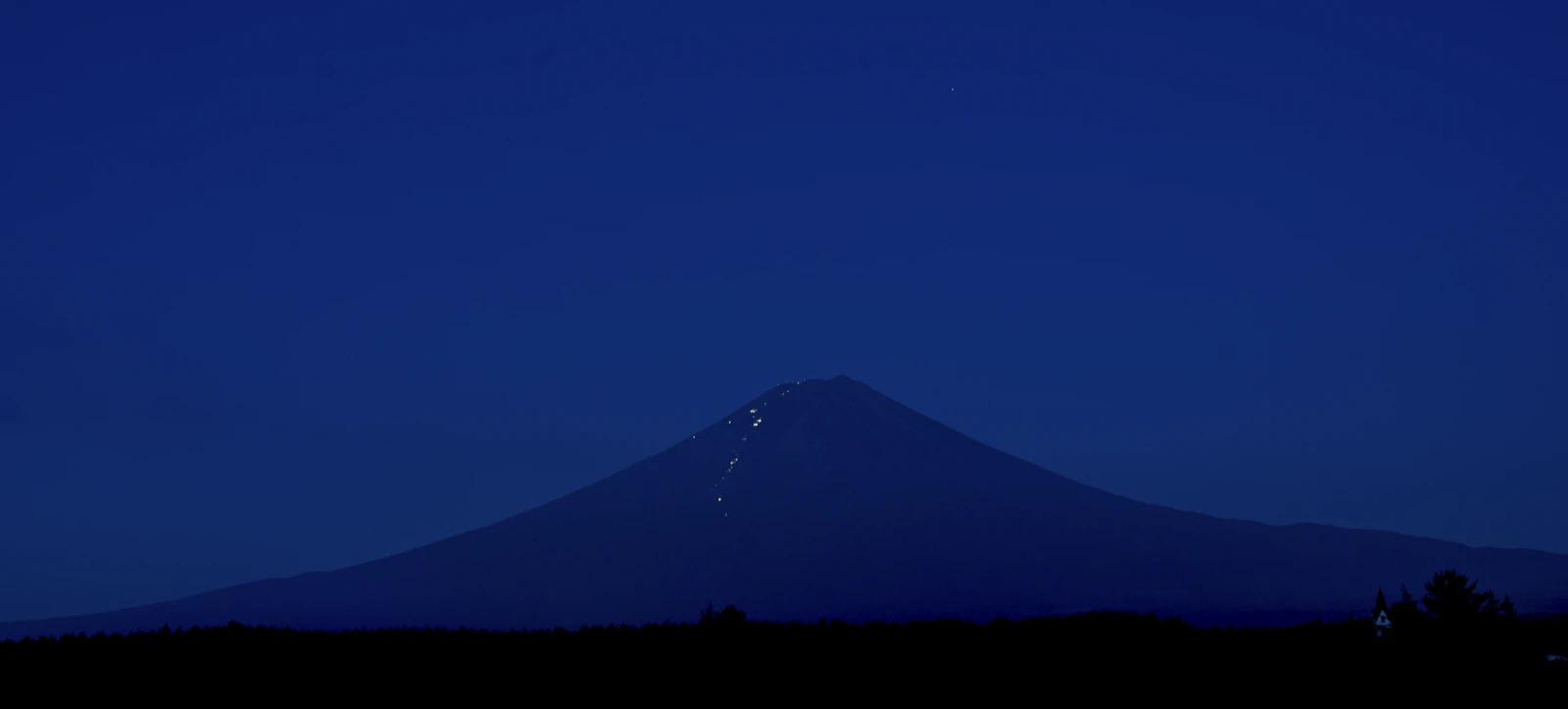
In the photo above, the line of lights climbing Mount Fuji isn’t a road. It’s headlamps: people hiking through the night to watch the sunrise from the summit. That’s exactly the kind of climb Japan has decided to rein in. Since 2025, anyone going up any of the four official trails pays ¥4,000 and has to register in advance. Under the 2026 rules, between 2 p.m. and 3 a.m. only people with a booking at one of the mountain huts are allowed onto the mountain.
The fee is partly about managing overcrowding, which on a 3,776-meter mountain is also a safety issue.
From free to ¥4,000 in two years
The first trail to charge was the Yoshida Trail, on the Yamanashi side and the busiest of the four. In 2024 it started charging ¥2,000 and added a gate that closes once 4,000 people have gone up that day. The three trails on the Shizuoka side (Fujinomiya, Subashiri and Gotemba) stayed free that year. In 2025, all four began charging ¥4,000 and requiring advance registration. The rules stayed the same in 2026. Climbers can also leave an optional ¥1,000 donation for the mountain’s conservation, which comes with a small wooden plaque as a souvenir.
The cap was set against real numbers. In 2023, before the rules, the Yoshida Trail saw 137,236 climbers between July 1 and September 10, an average of 1,906 a day, peaking at 3,974 on July 16, almost exactly the ceiling adopted the following year. The figure also has a technical origin. When Fuji became a World Heritage site, ICOMOS, the body that advises UNESCO, asked for a visitor management plan. Under that plan, more than 4,000 climbers a day means the trail near the summit gets jammed before dawn, raising the risk of people knocking into each other’s poles and packs and falling.
How many people climb Fuji
Japan’s Ministry of the Environment counts climbers with infrared sensors at the 8th station of each of the four trails. In summer 2025, from the start of the season to September 10, there were about 205,000, almost exactly the same as 2024, which had around 204,000. In other words, the doubled fee of 2025 didn’t empty the mountain, and numbers held steady from one year to the next.
The trouble with overnight climbs
Plenty of people try to climb in one push, overnight, without stopping to sleep in a hut, so they can reach the top at sunrise and head straight back down. Kawaguchiko.net, a tourism site for the Yoshida Trail area, lists climbers who go up without proper rest among those causing problems for everyone else on the mountain.
The risk is real. The official climbing site notes that the climb from trailhead to summit is well over 1,000 vertical meters, and that temperatures fall about 0.6°C for every 100 meters. Wind makes it worse: each meter per second knocks roughly 1°C off how cold it feels. Even in summer, the summit can drop close to 0°C before sunrise, and the longer you wait around, the higher the risk of hypothermia. The curfew targets exactly that: without a hut booking, you have to start climbing in daylight.
A short season
Fuji is only open for climbing in summer, from early July to early September. The 2026 season ended on September 10. Outside that window, first-aid stations and huts are closed, phone coverage drops out and the weather can turn fast. The official site advises against climbing then.
Beyond the mountain: the Lawson screen
Overcrowding around Fuji isn’t limited to the trails. In May 2024, the town of Fujikawaguchiko, in Yamanashi, put up a black screen 20 metres long and 2.5 metres high along a pavement to hide the view of the mountain.
The reason was a photo famous on social media: from a certain angle, in front of a Lawson convenience store, Fuji appears to sit right on top of the shop’s roof. Tourists crowded the pavement and dashed across the road through traffic to get the shot. Local residents and businesses had had enough.
The screen didn’t solve everything. Visitors poked holes in the mesh to photograph the mountain. In August 2024, it was taken down as a precaution ahead of a typhoon and, according to Euronews, the authorities decided to leave it down, warning that it could return if the crowds came back. A town official said far fewer people were rushing out into the road.
In August 2025, a new barrier went up, much more discreet: a brown tarp about 1.4 metres high that leaves the mountain in view but keeps people off the road, according to Time Out Tokyo.
Before you go
- Pay and register in advance on the official site. Registration isn’t a hut booking; they’re separate.
- Want the sunrise from the top? Book a hut. Without one, you can’t enter between 2 p.m. and 3 a.m.
- Pack winter clothing, even in August. High-cut hiking boots, two-piece rain gear, a warm jacket, gloves and a headlamp are on the official list of essentials, and your gear may be checked before you set off.
- Bring cash and ¥100 coins. Huts and toilets on the trail are paid in cash.
- Carry your trash back down. A bag for your own rubbish is on the official list too, which won’t surprise anyone who knows why Japan has almost no public trash cans.
- Check the dates before you plan. Official dates for each season are announced before it starts.
FAQ
How much does it cost to climb Mount Fuji?
¥4,000 per person, on any of the four official trails, with advance registration. There’s also an optional ¥1,000 donation for the mountain’s conservation.
Do you need a reservation to climb Mount Fuji?
You need to register and pay the fee in advance. To climb between 2 p.m. and 3 a.m., you also need a booking at one of the mountain huts.
When can you climb Mount Fuji?
Only in summer, from early July to early September. Outside the season, huts and first-aid stations are closed, and the official site advises against climbing.
How many people climb Mount Fuji each year?
About 205,000 in summer 2025, according to the count by Japan’s Ministry of the Environment.
Is there a daily limit on Mount Fuji?
On the Yoshida Trail, the gate closes once more than 4,000 people have entered in a day.
The line of headlamps still makes a beautiful photo. The difference now is that every one of those lights paid to be there and, if it’s the middle of the night, slept in a hut first.
Sources
- Things you must know before climbing Mt. Fuji, the official Mt. Fuji climbing website: the ¥4,000 fee, the curfew, registration, the season, summit temperatures, how altitude and wind lower them, the vertical gain and required gear.
- the Official Website for Mt. Fuji Climbing, official site: the end of the 2026 season and the risks outside it.
- Mt Fuji has increased ticket prices for the 2025 climbing season, Time Out Tokyo, 2025: the rise from ¥2,000 to ¥4,000 and the new charge on the Shizuoka trails.
- Summary of Mt. Fuji climbing regulations and entrance fees, Kawaguchiko.net: the 2024 Yoshida Trail rules, the optional donation, 2023 climber numbers, the 4,000-climber limit and where that number comes from.
- 2025年夏期の富士山登山者数について, Japan’s Ministry of the Environment, September 29, 2025: about 205,000 climbers in 2025, versus 204,000 in 2024, and the counting method.
- ‘It has been effective’: Screen blocking Mount Fuji taken down, Euronews, August 22, 2024: the Fujikawaguchiko screen, its size, the reasons and its removal.
- The Mt Fuji barrier at Lawson in Kawaguchiko is back up again, Time Out Tokyo, August 15, 2025: the new 1.4-metre barrier.
Keep reading
Nature and geographyVeneza
MOSE: the sea gates that keep Venice from flooding
MOSE, Venice’s 78 sea gates, first rose in October 2020 after 17 years of work and scandal. What triggers them, what they miss, and what to know.

Nature and geographyFrance
Mont-Saint-Michel: the tides, the bridge and how to visit
Mont-Saint-Michel sits in a bay with a tide range of about 14 metres. Why it needed a new bridge in 2014, why the sands are risky and how to plan a visit.

Nature and geographySweden
Allemansrätten: camping on other people’s land in Sweden
In Sweden anyone can pitch a tent on someone else’s land for a night or two. What the right allows, plus the rules on fires, foraging and campervans.
